
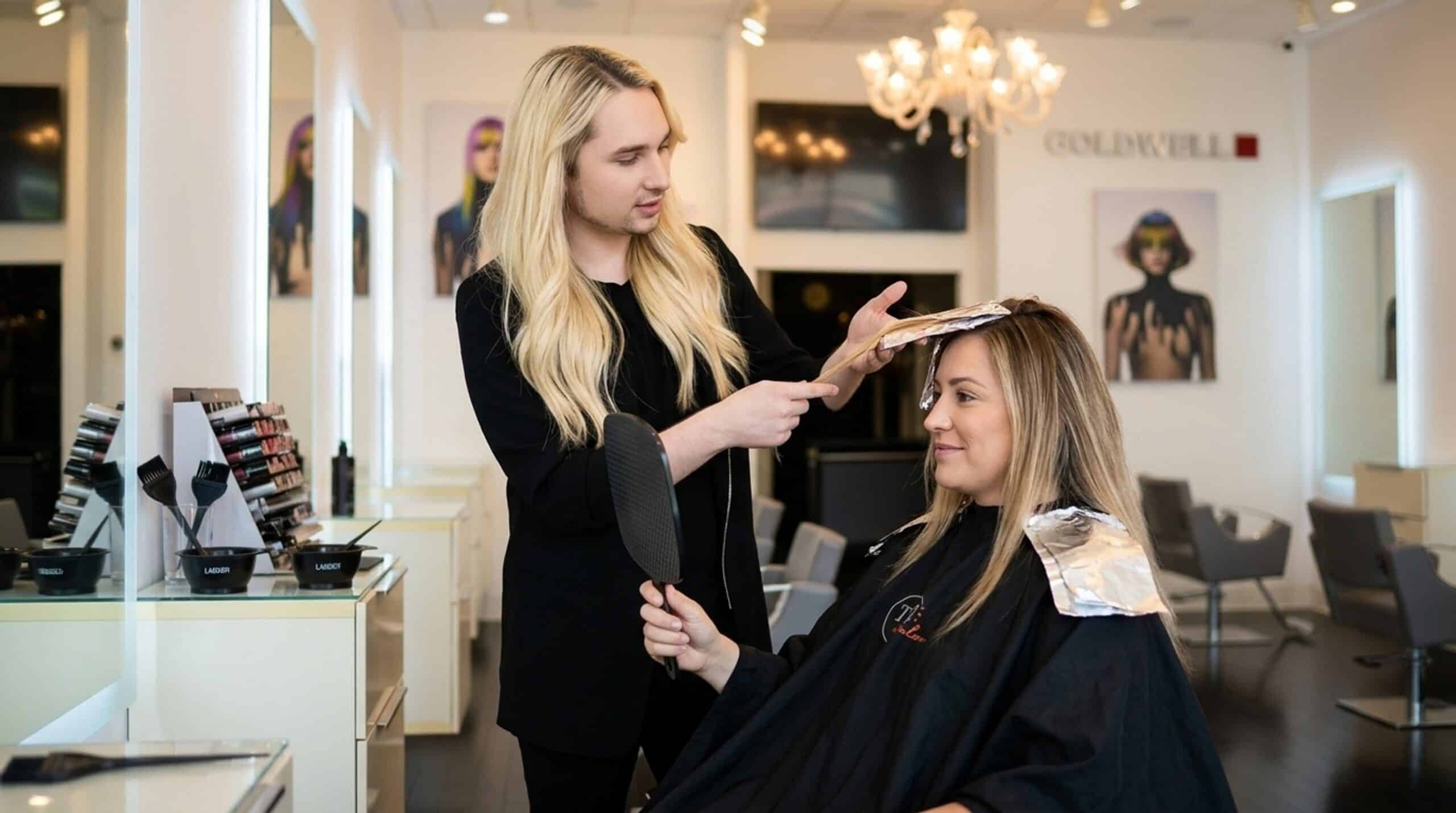
 October 9, 2026 | Hair Color
Full highlights every 8 to 12 weeks, partials every 6 to 10 weeks, root touch-ups every 3 to 6 weeks. That’s the range, and if three different stylists have given you three different numbers, they’re probably not wrong, they’re just answering for different hair. Your growth rate, your contrast level, and your hair’s condition decide where you land inside that range, which is exactly what a consultation for highlights at our Houston salon is designed to figure out.
Key Takeaways
- Full highlights generally need a refresh every 8 to 12 weeks, partials every 6 to 10 weeks, and root touch-ups every 3 to 6 weeks.
- Hair grows roughly half an inch per month, so visible regrowth tends to show up around the 6 to 8 week mark on high-contrast color.
- Balayage, foilayage, and babylights can stretch time between appointments to 12 to 16 weeks for a lower-maintenance look.
- Fine, thin, or already color-treated hair needs more space between lightening sessions to protect strand health.
- Houston’s humidity, sun, and hard water can fade color faster, which shortens the practical window before your next visit.
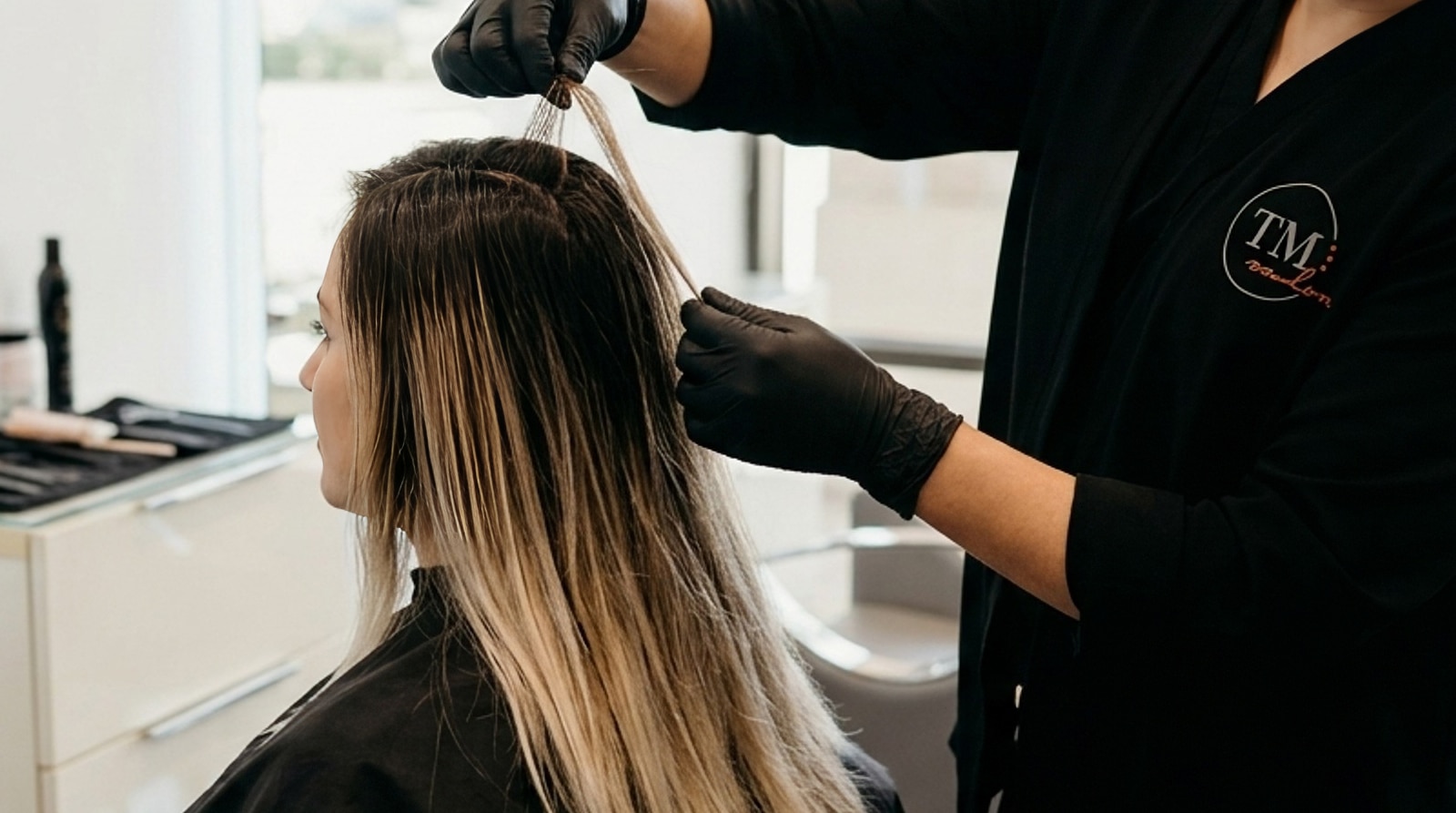
It Depends on These 5 Factors
There’s no single correct answer to how often you should sit in the color chair, and that’s good news. Your hair, your color goal, and your lifestyle pull the timeline in different directions. The “right” schedule comes down to five variables working together, not one magic number.
Growth Rate and Natural vs. Target Color Contrast
Hair grows about half an inch a month on average. By week eight, you’re typically looking at close to an inch of new growth. That math hits some people harder than others. A natural brunette lifting to bright blonde streaks will see a visible line far sooner than someone blending gray or going for a soft, tonal shift close to her natural shade. High contrast shows every week of growth. Low contrast hides it. That’s one reason warm brown bases tend to photograph as more forgiving between visits than stark blonde-on-dark combinations.
Technique, Porosity, and How Much Maintenance You Actually Want
The technique you choose changes everything downstream. Foils placed close to the scalp create a cleaner, more defined line, which also means a more obvious grow-out. Balayage and babylights are hand-placed or painted to taper naturally, so they blend as hair grows instead of showing a hard edge.
Porosity plays a role too. Hair that’s already been bleached tends to be more porous, so color processes faster and sometimes unevenly. That affects how soon it’s safe to lighten again. A bleach bath, for instance, is a gentler diffused-lightener option some colorists use on already-processed hair instead of running a full bleach application a second time.
Then there’s your maintenance appetite, which only you can answer honestly. Some women want zero visible regrowth, ever, and prefer frequent highlight touch-ups to keep that crisp, just-colored look year-round. Others are happy to stretch for months with a lived-in look. Both are valid. A stylist factors in all five variables, not just one, when mapping your calendar. If you’re not sure where your hair falls, that’s a normal thing to bring up at a consultation rather than something you’re expected to diagnose on your own.
Full Highlights vs. Partial Highlights: Which Schedule Fits You?
Full Highlights Schedule (8-12 Weeks): Signs You’re Due
A full highlight means foils or lightener applied throughout the entire head, not just around the face. It’s the right call for all-over dimension or a bigger color change, and it generally holds up for 8 to 12 weeks before it needs a refresh. You’ll know you’re due when the regrowth is uniform all over your head, not just at the crown, and when the overall color has flattened out and lost its depth.
Partial Highlights Schedule (6-10 Weeks): Who This Suits
Partial highlights concentrate foils around the face, the crown, and the top layers only, leaving the underneath untouched. That targeted approach is why partials cost less and process faster than a full highlight. It’s also why the schedule runs a bit tighter, usually 6 to 10 weeks. This option suits clients who want brightness and face-framing dimension without exposing their whole head to bleach every time. It’s often the easiest way to book quick highlight touch-ups between bigger appointments, and many clients use these touch-ups to keep face-framing pieces bright without committing to a full re-highlight. If you’re weighing the two options in more depth, including price differences and coverage, our earlier breakdown of partial versus full highlights walks through the specifics.
In short: a full highlight reprocesses everything, and a partial touch-up targets only the sections that show the most. Knowing which one you actually need before you call keeps your budget and your appointment length realistic.
Root Touch-Up Schedule: Roots vs. a Full Re-Highlight
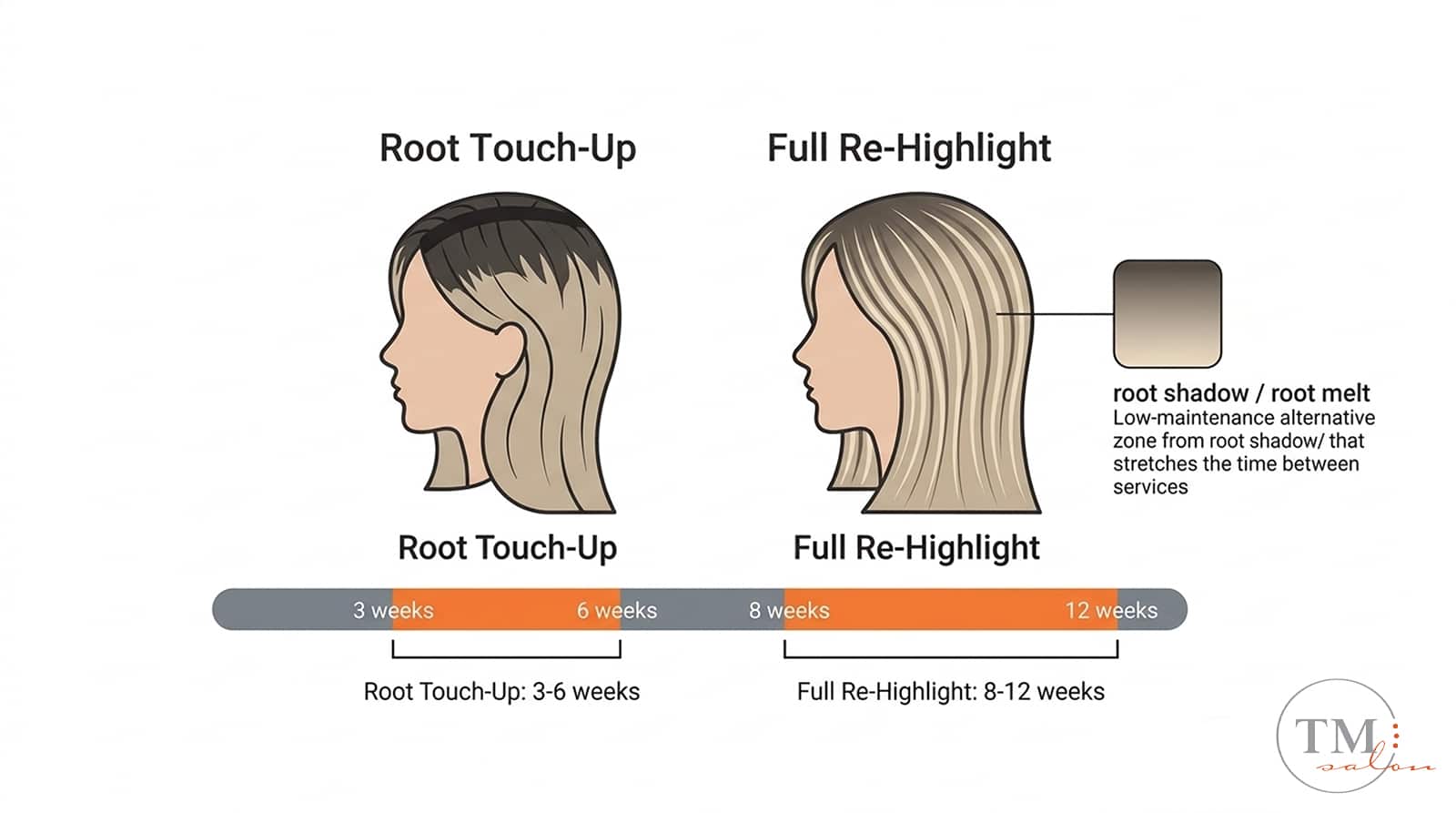
Root Touch-Up vs. Full Re-Highlight: What’s Actually Different
A root touch-up only reprocesses the new growth at your scalp, not the rest of your hair. For high-contrast color, like a dark natural base lightened to blonde, that typically means visiting every 3 to 6 weeks. Lower-contrast color can stretch longer between touch-ups. Because a root touch-up skips the mid-lengths and ends entirely, it’s gentler on strands that have already been through a bleaching process, and it’s noticeably faster than a full re-highlight.
This distinction matters for your wallet and your hair’s condition. A full re-highlight resets the whole canvas. A root touch-up simply catches up the new growth so there’s no obvious line. Confusing the two is one of the most common reasons clients either overpay or walk out with uneven color, and it’s a completely fair thing to clarify with your stylist before you sit down.
Root Shadowing and Root Melt as a Low-Maintenance Option
If you’re tired of chasing a hard line every few weeks, root shadowing, sometimes called root melt, is worth asking about. It blends a soft shadow at the part and hairline so regrowth looks intentional instead of abrupt, which stretches the time between full services considerably. Pairing it with lowlights near the part can deepen that blend even further. It’s a smart middle ground for someone who isn’t ready to commit to full hair coloring maintenance but also doesn’t love a sharp root line showing up in photos.
Highlight Schedule at a Glance (Comparison Table) + Low-Maintenance Alternatives
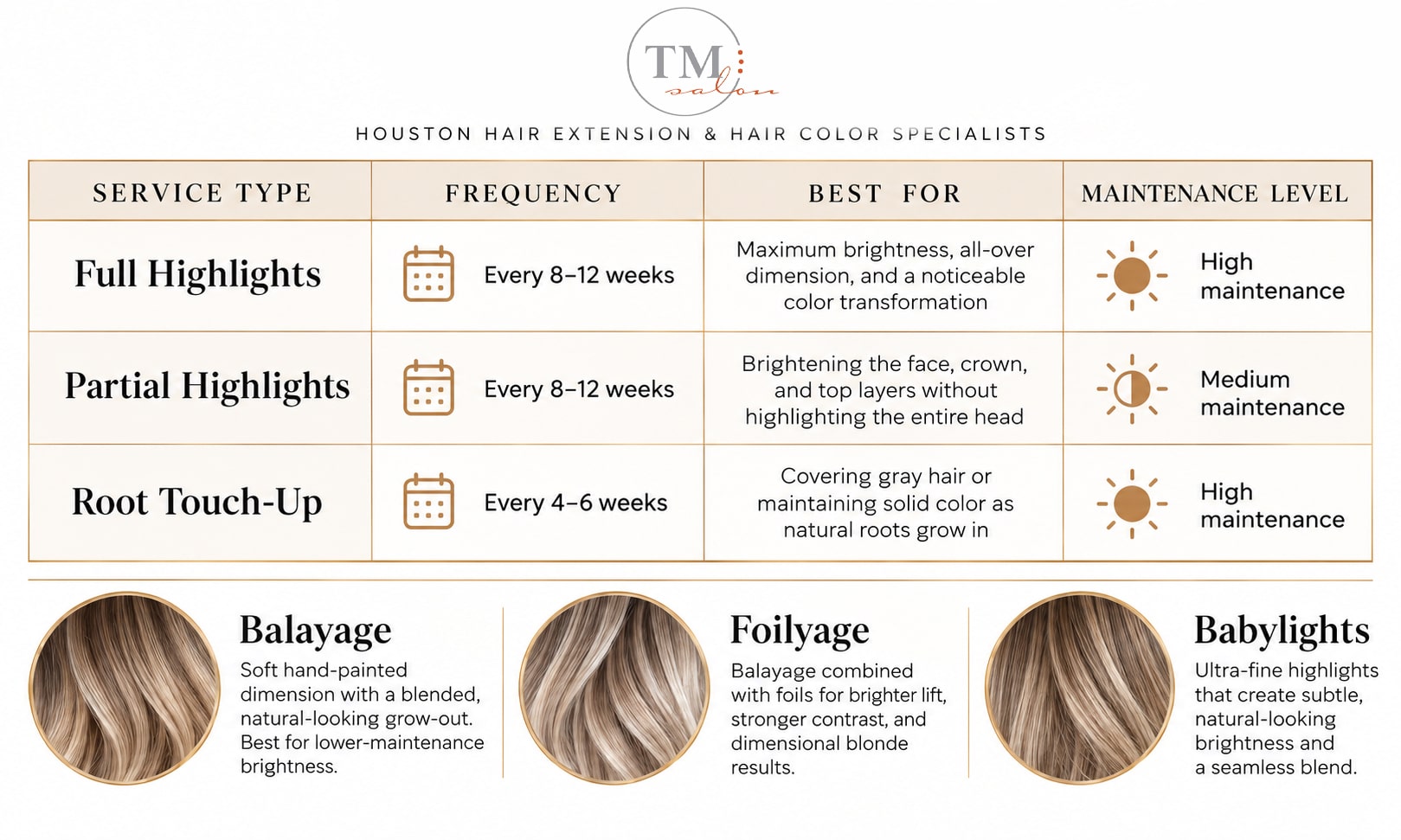
Highlight Schedule at a Glance
Here’s the full highlight schedule side by side, so you can see where your current color and goals land.
| Service type | Frequency | Best for | Approx. maintenance level |
|---|---|---|---|
| Full highlights | 8-12 weeks | All-over dimension, major color change | High |
| Partial highlights | 6-10 weeks | Face-framing brightness, lower cost | Medium |
| Root touch-up | 3-6 weeks | High-contrast color, fast-growing roots | Medium-High |
| Root shadow/melt | 10-14 weeks | Soft regrowth blend, low-maintenance look | Low-Medium |
| Balayage/babylights/foilayage | 12-16 weeks | Lived-in, low-maintenance color | Low |
Balayage, Foilayage, and Babylights for Longer Stretches Between Visits
If the table above tells you anything, it’s that technique changes your calendar more than almost any other factor. Balayage is hand-painted directly onto the hair rather than through foil packets, creating a soft, sun-kissed gradient that grows out without a visible line. Foilayage combines painted balayage with foils to lift certain sections brighter while keeping that same soft grow-out pattern. Babylights are fine, delicate highlights meant to mimic natural sun lightening. Because they’re so subtle, regrowth is far less noticeable. These techniques also let your stylist blend warm and cool colors within the same head of hair, which is part of why the dimension reads as natural rather than stripy.
All three can stretch a visit out to 12 to 16 weeks for clients who want a low-maintenance look over maximum brightness. We also recommend bond-building treatments like Olaplex alongside any lightening process. Protecting the internal strand structure is what allows hair to hold up over months and years, not just one appointment.
One of our longtime clients came to us with fine, color-treated hair that had been lightened too often at her previous salon, leaving it dry and prone to snapping. After switching her to a babylights technique paired with Olaplex treatments, she now goes 14 weeks between visits with noticeably stronger strands and far less visible regrowth in between. A stylist can tell you honestly which of these techniques fits your hair and your calendar before you commit, and can also recommend quick touch ups for face-framing pieces if you want extra brightness before the full 14-week mark.
Signs You’re Overdue vs. Signs You’re Over-Processing Your Highlighted Hair
Signs You’re Overdue for a Highlight Appointment
Your hair usually tells you before you have to guess. Watch for these signals that it’s time to book:
- A visible regrowth line past about an inch
- Highlights that look brassy, yellow, or dull instead of bright
- Flattened dimension, where the color looks like one solid tone again
- Toner that’s faded and needs a refresh to stay cool-toned
- Highlights fading faster than expected, leaving warm or brassy undertones where cool brightness used to be
Signs Your Highlighted Hair Is Over-Processed
On the flip side, going too often carries real risk, especially for fine or previously bleached hair. Here’s what over-processing looks like:
- Breakage or strands that snap rather than stretch
- A gummy, mushy texture when hair is wet
- Persistent dryness that conditioner doesn’t fix
- Scalp sensitivity or irritation after repeated applications
If any of these sound familiar, it’s worth having your hair looked at in person before your next color appointment rather than after. A quick consultation can usually tell you whether you need a break, a bond treatment, or just a gentler technique going forward.
So, is it bad to get full highlights every 4 weeks? For high-contrast blonde highlights, reprocessing the entire head that often is usually too aggressive and risks compounding damage on hair that’s already been lightened. A root-only touch-up at that interval, though, is often completely fine since it avoids re-bleaching hair that’s already processed. Fine hair and extension clients especially benefit from extra spacing, since thinner strands have less structural reserve to absorb repeated lightening sessions. Color maintenance also looks a little different for anyone combining highlights with extensions, our Natural Beaded Rows clients included, since protecting strand integrity has to come first.
Houston adds its own wrinkle here. High humidity causes the hair cuticle to swell and lift, which lets color molecules escape faster than they would in a drier climate. Add in strong Gulf Coast sun, which breaks down color molecules through UV exposure, and Houston’s notoriously hard water, which deposits minerals on the hair shaft and dulls tone, and you’ve got three local factors working against your color at once. In practice, this means highlights fade noticeably faster here than they would in a milder climate, which is exactly why many Houston clients find they need toner refreshes or touch ups a few weeks sooner than the general schedule suggests. Clients near our Louetta Road salon, including those closer to the Vintage Park area, often find their highlight touch-ups need to happen a touch sooner than the same service would hold up somewhere drier. Worth factoring into your own timeline.
Conclusion
The honest answer to how often you should get highlights is that it depends on you. Specifically, your growth rate, your natural color, the technique used, and how your hair has held up to past processing. As a general guide, plan on full highlights every 8 to 12 weeks, partials every 6 to 10 weeks, and root touch-ups every 3 to 6 weeks. From there, your stylist refines those ranges into something built around your actual hair color and texture, not a generic chart.
You now have the language for what you need, whether that’s a full highlight, a partial, a root touch-up, or root melt, and the understanding that your own hair is what sets the clock. The only thing left is turning that range into your actual calendar. If you’d like a second opinion on where your hair falls in all this, call Trademark Salon at (832) 717-3422 to talk it through, no pressure to book anything on the spot.
FAQ
How often should you get your roots touched up after highlights?
Roots typically need a touch-up every 3 to 6 weeks after highlights, depending on growth rate and contrast level. High-contrast color, like dark roots against blonde, shows regrowth faster and needs more frequent attention, while lower-contrast color can stretch closer to the 6-week mark. A stylist can check your regrowth speed in person and set a more exact interval for you.
Is it bad to get highlights every 4 weeks?
Full re-processing every 4 weeks is generally too frequent for bleached or high-contrast hair and can compound damage on strands that are already lightened. A root-only touch-up at that same interval, however, is often perfectly safe since it avoids reprocessing hair that’s already been colored. A quick porosity check at your salon visit is the safest way to confirm which one applies to you.
How long do highlights last before they grow out?
Highlights don’t disappear so much as grow out, with a visible regrowth line typically appearing around 6 to 8 weeks for high-contrast color. Softer techniques like balayage or babylights can look fresh for 12 to 16 weeks since they’re designed to blend rather than create a hard line. Choosing the right technique upfront is a decision your stylist should help you make based on how low-maintenance you want your color to be.
What’s the difference between a full highlight and a partial highlight touch-up?
A full highlight reprocesses the entire head of hair, while a partial touches up only the top layers and face-framing sections. That’s why partials typically cost less and take less time in the chair. A consultation is the best way to determine which one matches your current regrowth and your budget.
Can you get highlights too often?
Yes. Over-lightening hair too frequently compromises strand integrity and can lead to breakage, particularly on fine or previously color-treated hair. Repeated bleach sessions strip moisture and weaken the internal structure of each strand over time. A professional strand and porosity check before booking your next appointment is the safest way to avoid pushing your hair past what it can handle.
How often should blondes get highlights to maintain color?
Blondes typically need root touch-ups every 3 to 6 weeks along with a toner refresh every 4 to 6 weeks to prevent brassiness between full appointments. The toner fades faster than the underlying highlight itself, which is why many blonde clients come in for toner-only visits between bigger color sessions. A maintenance plan built around your specific blonde level, whether that’s a cool platinum, a warmer honey tone, or a rich brown base with subtle dimension, is something your stylist can map out at your next visit.